

Our story
A thousand years in a jar
Some foods are not only to fill you, but to remember by. Mắm is one of them: a jar in a Vietnamese kitchen holds a whole river, a whole flood season, the hands of a grandmother and a mother — and more than a thousand years of history.
Part I
A history of Vietnamese mắm

Mắm in the chronicles
Mắm is no modern invention. It appears in Vietnam's official chronicles more than a thousand years ago.
The earliest surviving record is in the Đại Việt sử ký toàn thư, in the fourth year of Ứng Thiên under Lê Đại Hành — the year 997: envoys of the Song court "would use the pretext of demanding fish sauce as tribute" to extract goods from the people. A fish condiment made by Vietnamese households, wanted badly enough that the northern court sent for it.
By 1013, under Lý Thái Tổ, Phan Huy Chú's Lịch triều hiến chương loại chí records that the court listed fish sauce among six local products accepted as payment in kind, in place of the head tax. Mắm was already a commodity with economic value, not merely a household food.
In 1415, under Ming occupation, the Ming administration tightened control over the making and movement of salt and fish sauce: a traveller was allowed to carry only three bowls of salt and one jar of fish sauce. A thing is monopolised because it is essential.
“Envoys of the Song court would use the pretext of demanding fish sauce as tribute.”
Đại Việt sử ký toàn thư, Lê dynasty, vol. 1
997 — the earliest record of Vietnamese fish sauce in the official chronicles.

Every region, its own mắm
Travel the length of the country and almost every region has a mắm of its own, made from whatever its waters give.
The north has mắm tôm, ground from tiny sea shrimp — deep purple and pungent, indispensable to bún đậu and giả cầy. The coastal provinces of Thái Bình, Nam Định and Thanh Hoá add mắm tép and the mắm cáy of the paddy fields.
The centre is harsher, and so is its mắm: the shrimp paste of Huế, the mắm nêm of Đà Nẵng, the sweet-and-sour fermented shrimp of Huế eaten with boiled pork and green fig. The fish sauces of Phan Thiết, Nha Trang and Phú Quốc put Vietnam on the world map.
But only in the Mekong Delta did mắm become a whole family of dishes — freshwater fermented fish, eaten raw, steamed, fried, braised and in hotpot. Because only here is there a season with more fish than people can eat: the rising-water season.
Flood season, season of fish
Every year, when the waters come down from the upper Mekong, the delta becomes a vast inland sea.
People here do not call it a flood. They call it mùa nước nổi — the rising-water season — when silt enriches the fields and cá linh fish arrive with the current in shoals so dense that there is a saying: cá linh is cheap as duckweed. Cá linh, gourami, snakehead, cá chốt and cá trèn breed in the flooded fields and grow fat on the silt.
But the water always recedes. There are more fish than can be eaten or sold, and in those days there were no refrigerators. So people found a way to keep heaven's gift: salt the fish, press it into clay jars, and let time do the rest.
Mắm was born of that thrift and skill — turning a short season of fish into food for a whole year. Come November, when the fish move from the fields into the rivers, the whole hamlet stirs: the men fish, while women and children clean the catch, paid by the kilo.
“Mắm is how the people of the delta keep the flood season inside a jar.”
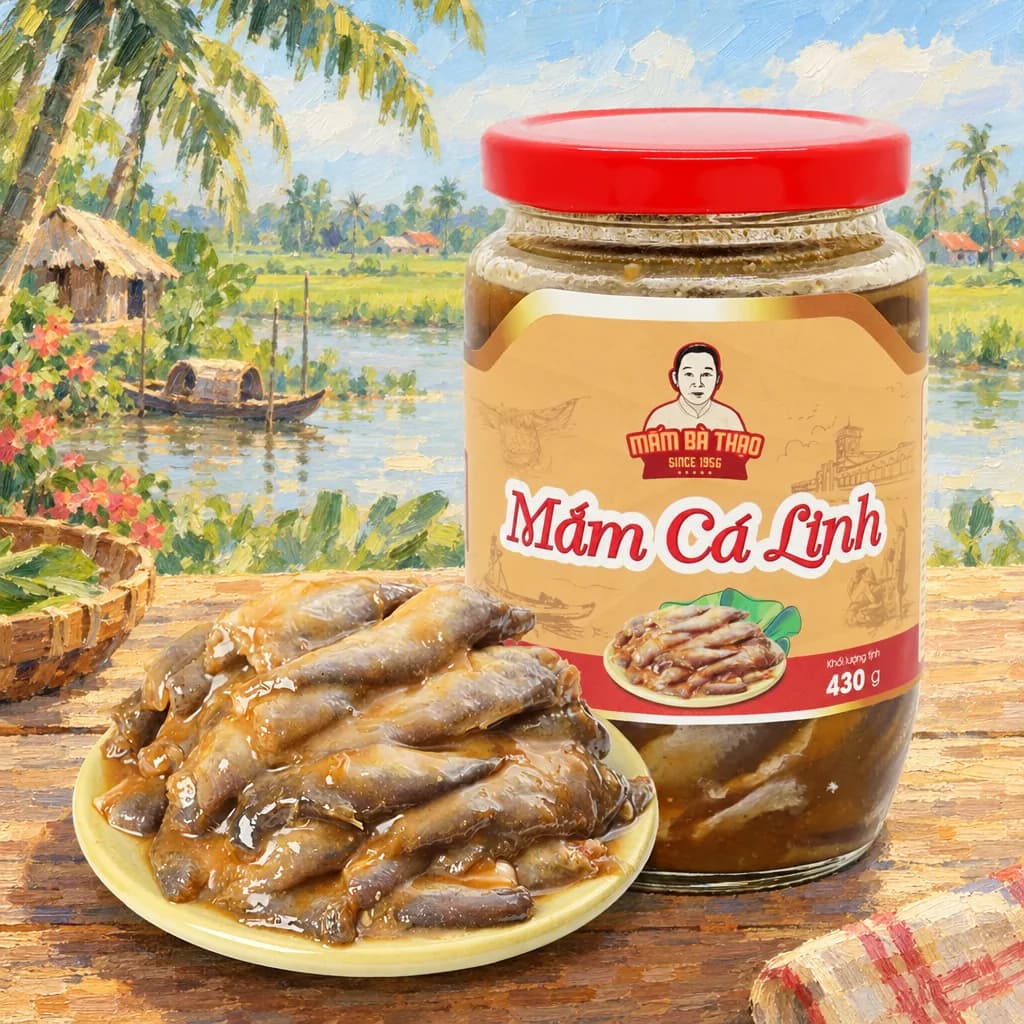
Fermented Cá Linh Fish
Related products
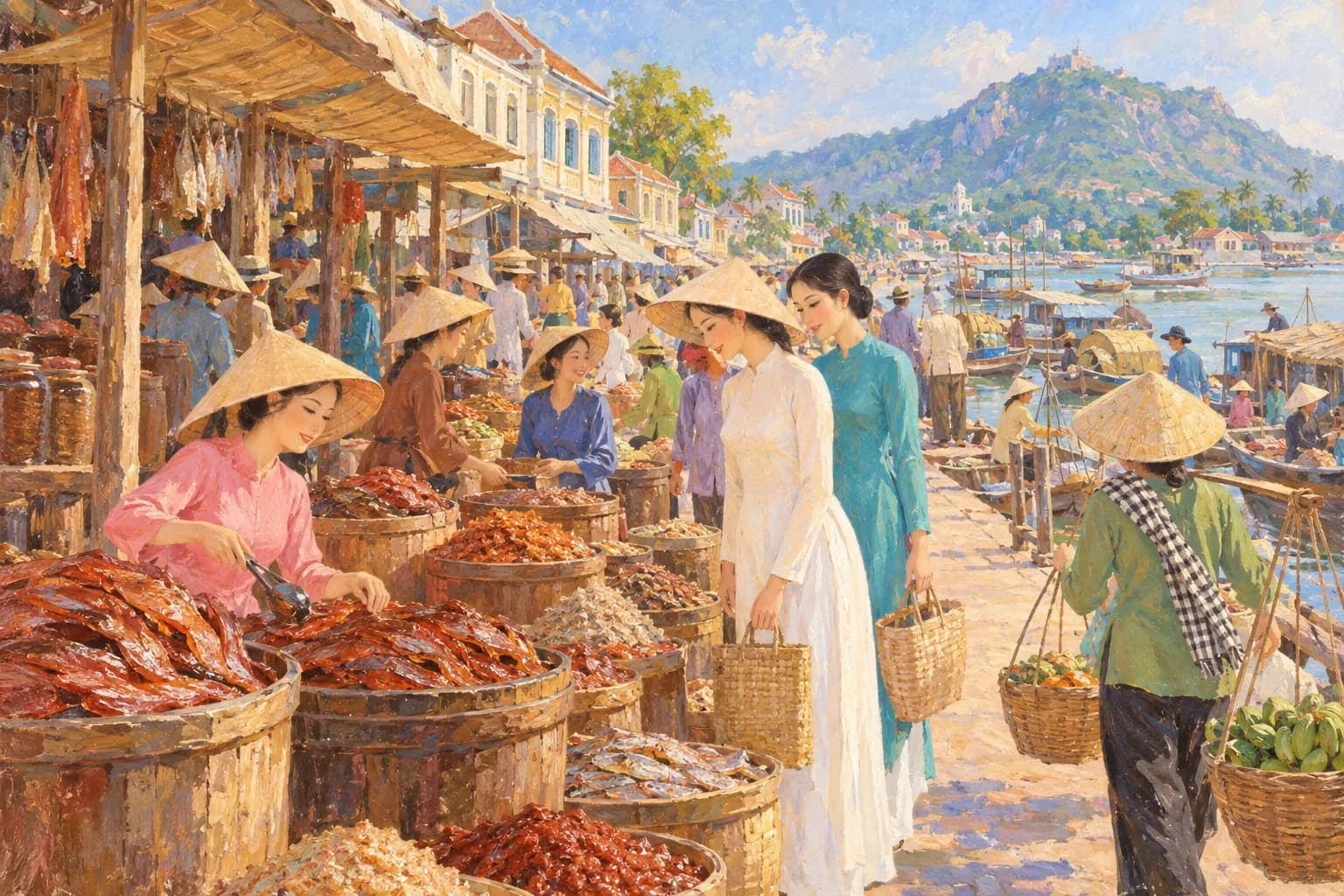
Châu Đốc, kingdom of mắm
At the confluence of the Tiền and Hậu rivers, close to the Cambodian border, Châu Đốc has long been called the kingdom of mắm.
Its craft village has been making mắm for more than a hundred years. Châu Đốc market has whole rows of stalls selling nothing else: dozens of kinds heaped in basins, amber and deep red, their aroma filling a corner of the market. Pilgrims to the Lady of the Realm temple at Sam Mountain carry home a few kilos as gifts.
More than a hundred households live by the craft, among them long-standing names such as Mắm Bà Giáo Khỏe, Cô Tư Ấu and Bà Giáo Thảo. The city of Châu Đốc alone produces hundreds of thousands of tonnes of fermented fish a year, sold across Vietnam and exported to Cambodia and Laos.
In April 2022 Châu Đốc was recognised as the locality with the most Southern-style mắm producers in Vietnam. The city also holds two collective trademarks: Châu Đốc specialty mắm, and Châu Đốc specialty mắm thái.
Vietnam Records, April 2022
Châu Đốc — the locality with the most Southern-style mắm producers in the country.
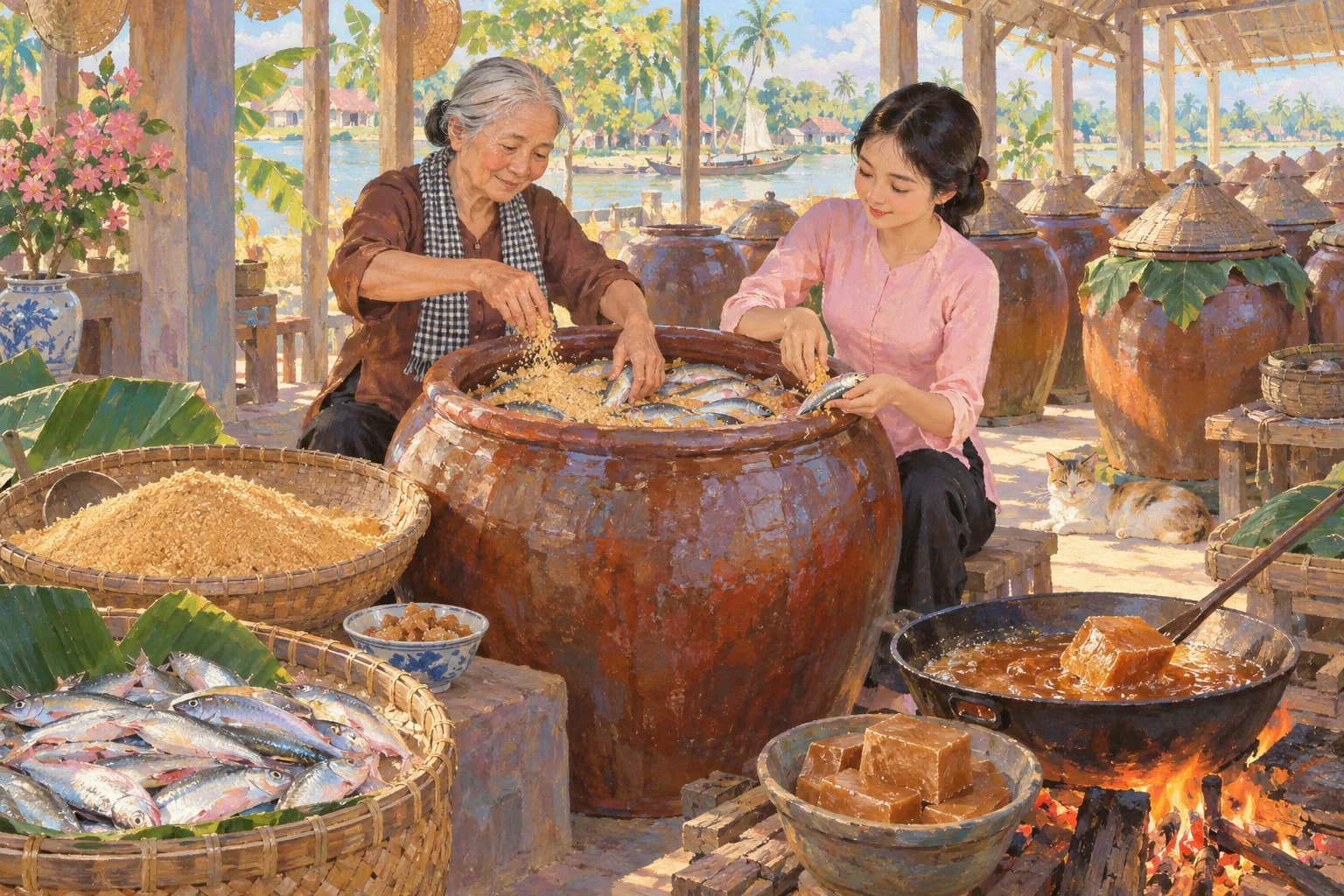
The maker's secret
It looks simple: fish and salt. But from a fish to a ripe jar of mắm is a process counted in months, and every house keeps its own formula.
The fish are sorted, cleaned, then salted with coarse salt in clay jars for about thirty days until fully cured. They are rinsed, drained thoroughly, then coated in thính — rice roasted golden and finely ground. Thính gives mắm its distinctive fragrance and its red-brown colour.
The coated fish are layered into jars, pressed under palm sheaths and crossed bamboo strips, then topped with a layer of fish sauce so no fish is exposed. Two to three months later, when the liquid in the jar turns a clear red, the mắm is ripe.
The final step — and the secret behind the Châu Đốc taste — is chao: palm sugar is caramelised, cooled, then mixed into the mắm for its gentle sweetness. The mắm rests another three to five days before it is eaten. It cannot be hurried.
“Thính for fragrance, palm sugar for sweetness, and time for everything else.”
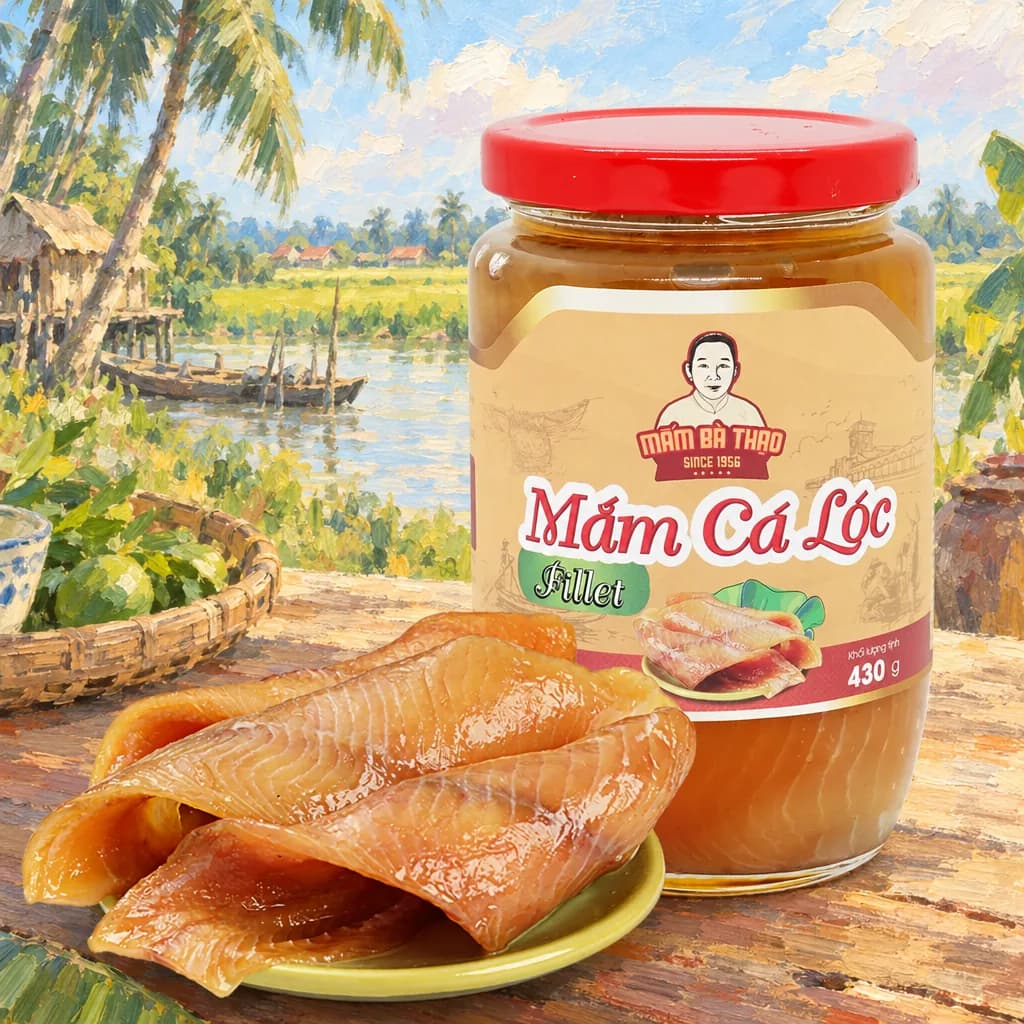
Fermented Snakehead Fish Fillet
Related products

Mắm on the table
In the delta, mắm is not a side dish. Mắm can be the whole meal.
Mắm steamed with duck egg and minced pork, with cucumber and green banana. Raw mắm wrapped with boiled pork and herbs in rice paper. Snakehead mắm — called the queen of all mắm — fried and eaten with hot rice.
And above all lẩu mắm: a broth made from fermented gourami and cá linh, into which go fish, prawns, pork belly and aubergine, with a tray of wild delta greens — water lily stems, sesbania flowers, bitter herb, kèo nèo, water mimosa. A pot of lẩu mắm is a portrait of the whole delta.
Beyond fish there is sweet-and-sour fermented shrimp, rich shrimp paste, the briny ba khía crab of the coast, and the pickled vegetables — cucumber, melon, papaya, cà pháo eggplant — crisp in mắm and perfect with plain rice.
“A pot of lẩu mắm is a portrait of the whole delta.”
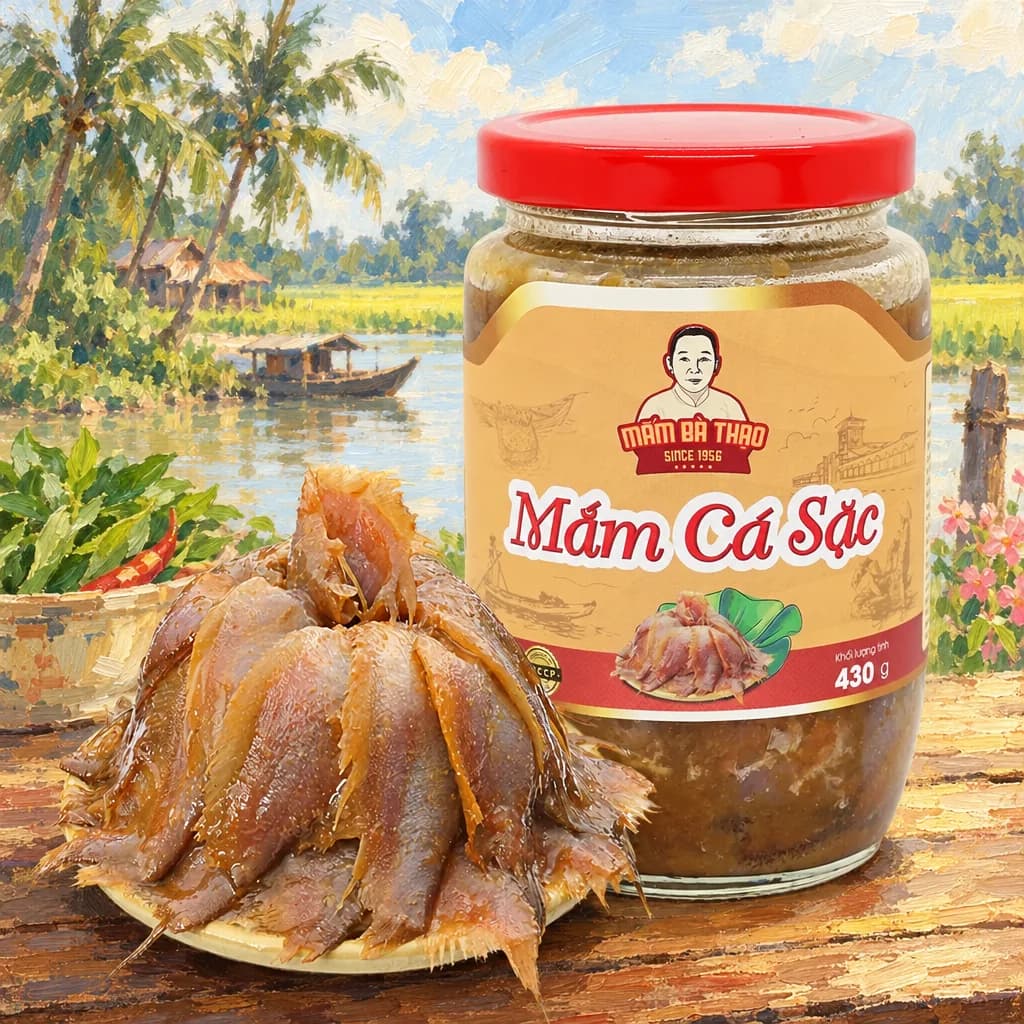
Fermented Gourami (Mắm Cá Sặc)
Related products
Part II
The story of Mắm Bà Thạo

The woman beside the jars
In 1956, in Châu Đốc, An Giang, Bà Ba Thạo cured the first batches of mắm to carry her name.
She began with nothing but a few clay jars, the fish of the river in front of her house, and a craft learned from her own neighbourhood. The mắm was sold at the market and sent to relatives far away, and word travelled — customers began arriving at her door.
What has kept the name alive for nearly seventy years is no hidden trick, but a plain rule: the fish must be wild, the salting must have its full days, the thính must be fragrant, and the palm sugar must be real. Every stage is still done by hand, because only hands keep the old flavour.
"Bà Ba Thạo" stopped being the name of a person and became the name of a way of making mắm.
Where it began
1956 — Bà Ba Thạo founds her mắm craft in Châu Đốc, An Giang.
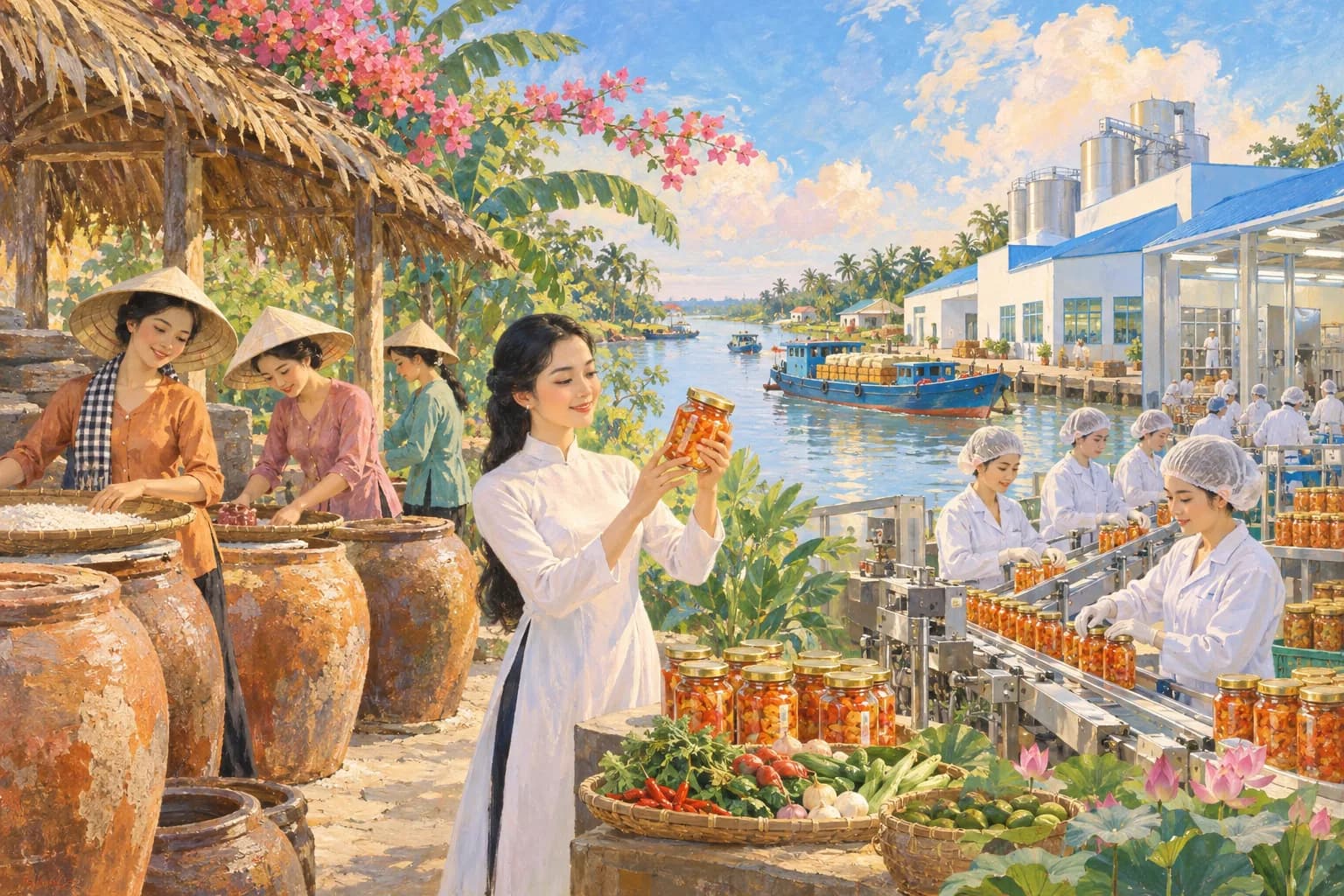
From clay jar to riverside factory
Keeping a craft does not mean standing still. In 2018 the Mắm Bà Thạo factory rose on the riverbank at Cần Đước, Long An.
Seven thousand square metres, a capacity of two thousand tonnes a year. But the method did not change: the fish is still cured in jars, still coated in thính, still finished with caramelised palm sugar, still measured in months. What is new lies elsewhere — in control.
Incoming ingredients are inspected, the plant is built to food-safety standards, and the product is packed in clean glass jars. Mắm Bà Thạo went on to earn HACCP certification, an ISO 22000:2018 certificate, food-safety certification and OCOP recognition, and registered its facility with the U.S. Food and Drug Administration.
In 2020 Mắm Bà Thạo Co., Ltd. was established in District 1, Ho Chi Minh City. In 2022 Bà Ba Thạo Co., Ltd. followed in Cần Đước. A grandmother's craft now stands on a complete legal footing.
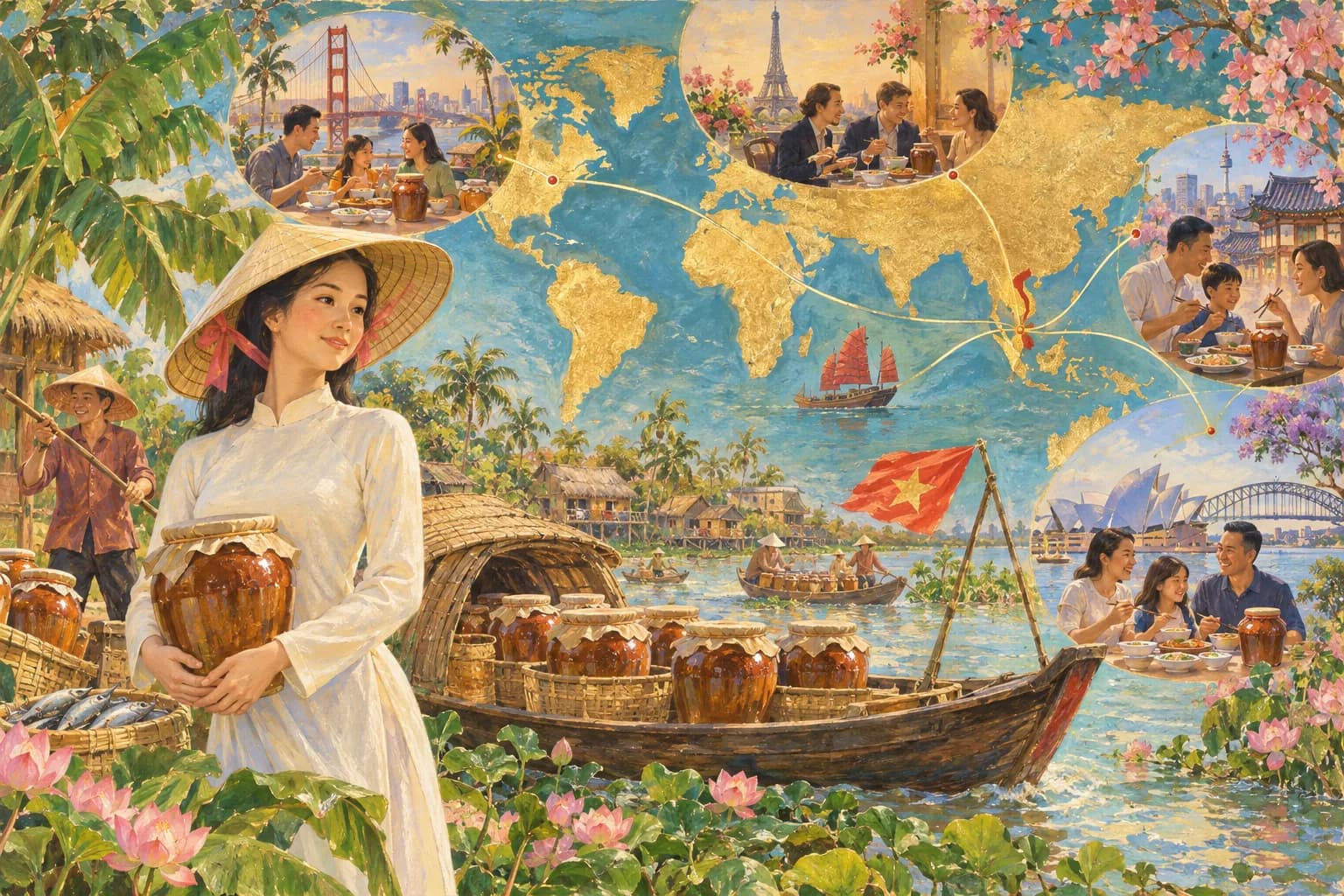
A taste of home, across five continents
Mắm Bà Thạo now offers thirty-two products in three groups: fermented fish, pickled vegetables, and ready-to-eat.
For those who have gone away, the smell of mắm is the smell of home. A jar sent from the village to the city, or carried in a suitcase to Australia, America or Korea, holds the river, the flood season, the family meal.
Making mắm is therefore not only making food; it is keeping a shared memory. Every jar that leaves the factory carries a promise: that what you open in a kitchen half a world away is still the true taste of the delta — honest, unpretentious and full-bodied, like its people.
“Mắm Bà Thạo — food and seasoning for every meal.”
Sources
- Đại Việt sử ký toàn thư, Kỷ nhà Lê quyển 1 (năm 997) và quyển 9 (năm 1415)
- Phan Huy Chú, Lịch triều hiến chương loại chí (1821), Quốc dụng chí — thuế biệt nạp năm 1013
- Báo Nhân Dân, “Nghề mắm ở An Giang” (2023) — làng nghề, thương hiệu lâu đời, sản lượng
- Báo Pháp luật Việt Nam, “Vương quốc mắm miền Tây” — quy trình ủ mắm truyền thống Châu Đốc